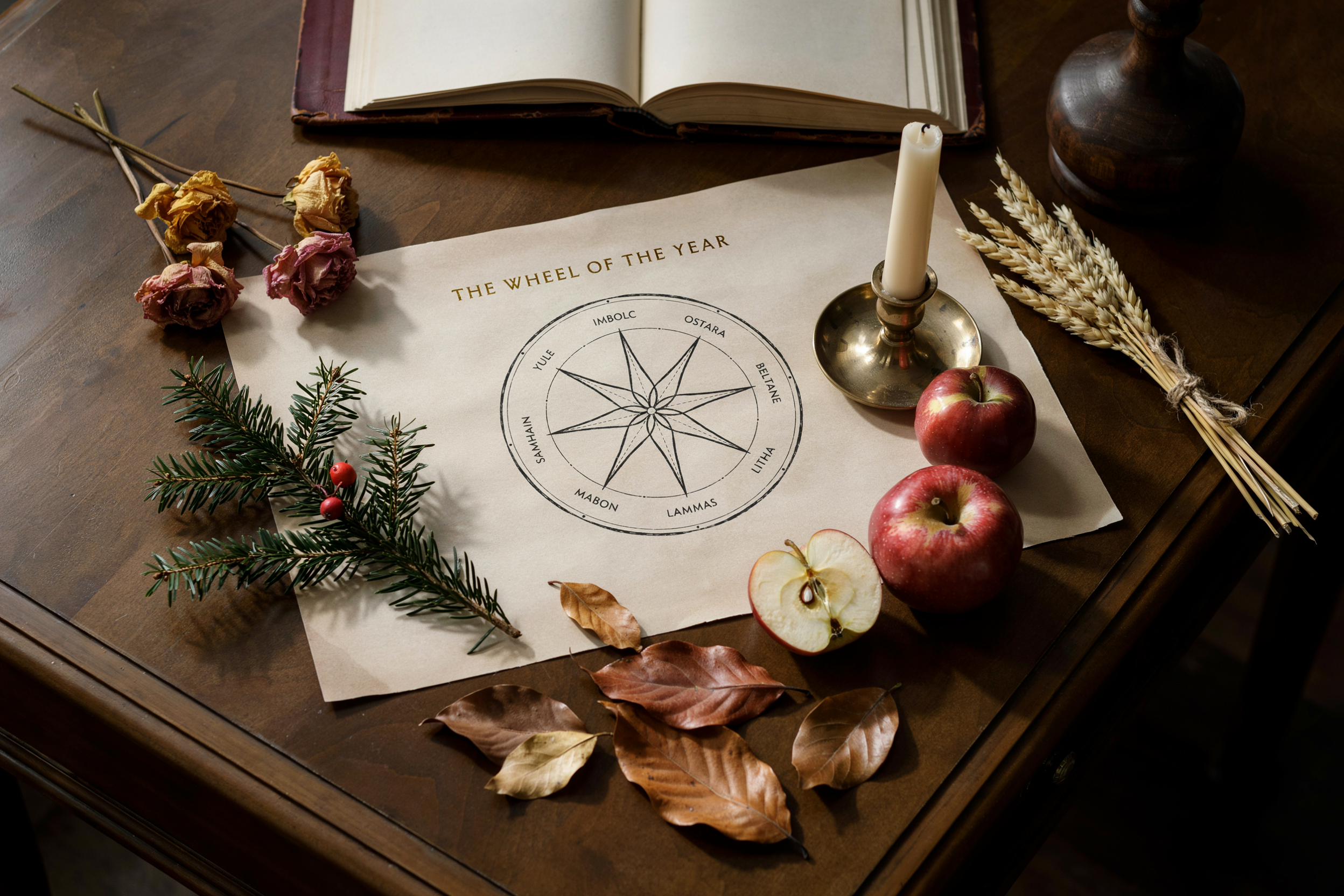
The Wheel of the Year is a modern pagan and witchcraft calendar that marks the annual cycle of seasonal festivals, solar turning points, agricultural rhythms, and symbolic transitions through the year. It is most commonly associated with eight seasonal observances, often called sabbats.
In many forms of modern witchcraft, the Wheel of the Year is used to honor the changing seasons, the cycles of light and darkness, the movement from death to renewal, and the recurring patterns of nature.
Definition of Wheel of the Year
The Wheel of the Year is an annual cycle of eight seasonal festivals observed in many modern pagan, Wiccan, and witchcraft traditions.
These festivals include the solstices, equinoxes, and four cross-quarter days. Together, they form a symbolic calendar that follows the changing relationship between the Sun, the Earth, and the seasons.
The Wheel of the Year is not a single ancient calendar preserved unchanged from the past. It is a modern ritual structure influenced by folklore, agricultural customs, seasonal festivals, ceremonial practice, and modern pagan religion.
Meaning of the Wheel of the Year in Witchcraft
In witchcraft, the Wheel of the Year is often used as a framework for seasonal awareness. Each point on the wheel represents a shift in the natural world and a corresponding spiritual theme.
The cycle begins in darkness, moves toward renewal and growth, reaches fullness and harvest, then returns again to descent, rest, and mystery. This pattern may be interpreted as a cycle of birth, life, death, and rebirth.
For many witches, the Wheel of the Year is a way to place magical practice within time. It connects ritual to the land, the light, the weather, the harvest, and the visible signs of change.
The Eight Sabbats of the Wheel of the Year
The Wheel of the Year is commonly divided into eight sabbats:
- Samhain
- Yule
- Imbolc
- Ostara
- Beltane
- Litha
- Lughnasadh
- Mabon
These sabbats are often grouped into two categories: the solar festivals and the cross-quarter festivals.
Solar Festivals
The solar festivals mark the solstices and equinoxes. They are connected to the changing balance of daylight and darkness.
Yule
Yule is the winter solstice. It marks the longest night of the year and the symbolic return of the Sun.
Yule is often associated with rebirth, stillness, darkness, hope, renewal, evergreen plants, candles, firelight, and the slow return of light.
Ostara
Ostara is the spring equinox. It marks a point of balance between light and darkness as the year moves into visible growth.
Ostara is often associated with fertility, renewal, eggs, seeds, dawn, growth, flowers, balance, and awakening.
Litha
Litha is the summer solstice. It marks the longest day of the year and the height of solar power.
Litha is often associated with abundance, vitality, fire, sunlight, strength, herbs, protection, fullness, and celebration.
Mabon
Mabon is the autumn equinox. It marks a second point of balance between light and darkness as the year turns toward decline.
Mabon is often associated with harvest, gratitude, apples, grain, balance, preservation, reflection, and preparation for the darker half of the year.
Cross-Quarter Festivals
The cross-quarter festivals fall between the solstices and equinoxes. They mark seasonal thresholds and agricultural turning points.
Samhain
Samhain is often observed at the end of October or beginning of November. It marks the final harvest and the beginning of the darker half of the year.
Samhain is associated with ancestors, death, endings, divination, spirits, remembrance, the thinning of the veil, and the mysteries of the unseen.
Imbolc
Imbolc is often observed at the beginning of February. It marks the earliest signs of returning light and the first stirrings beneath winter.
Imbolc is associated with purification, hearth, milk, flame, candles, inspiration, renewal, and preparation.
Beltane
Beltane is often observed at the beginning of May. It marks the height of spring and the threshold into summer.
Beltane is associated with fertility, fire, flowers, vitality, desire, union, protection, growth, and celebration.
Lughnasadh
Lughnasadh, also called Lammas in some traditions, is often observed at the beginning of August. It marks the first harvest.
Lughnasadh is associated with grain, bread, skill, sacrifice, abundance, labor, gratitude, and the first fruits of the season.
Wheel of the Year Dates
The dates of the Wheel of the Year may vary slightly by tradition, hemisphere, location, and astronomical timing.
Common Northern Hemisphere dates include:
- Samhain: October 31 to November 1
- Yule: Around December 21
- Imbolc: February 1 to February 2
- Ostara: Around March 20
- Beltane: April 30 to May 1
- Litha: Around June 20 to June 21
- Lughnasadh: August 1
- Mabon: Around September 22
In the Southern Hemisphere, the seasonal meanings are often reversed so that the festivals align with the local season rather than the Northern Hemisphere calendar.
The Wheel as a Symbol
The wheel is a symbol of recurrence, movement, return, and continuity. In the Wheel of the Year, time is not represented as a straight line, but as a cycle.
Each season rises, fulfills itself, fades, and returns again. The wheel teaches repetition without stagnation. The same festivals arrive each year, but they are never met from the same place.
Symbolically, the Wheel of the Year may represent the cycle of the Sun, the life cycle, the agricultural year, the mythic death and rebirth of divine figures, the relationship between light and darkness, or the pattern of spiritual transformation.
Seasonal Themes of the Wheel
The Wheel of the Year is often interpreted through seasonal themes.
Common themes include:
- Winter: rest, darkness, protection, stillness, inner work
- Spring: renewal, cleansing, fertility, growth, beginnings
- Summer: vitality, abundance, power, action, celebration
- Autumn: harvest, gratitude, release, reflection, descent
These themes may be used in spellwork, altar design, journaling, ritual planning, divination, and seasonal living.
The Wheel of the Year and the Sun
The Wheel of the Year is deeply connected to the Sun’s apparent movement through the year. The solstices mark the extremes of daylight and darkness. The equinoxes mark moments of balance.
The cross-quarter days fall between these solar points and are often associated with seasonal thresholds: the beginning of winter, the first signs of spring, the arrival of summer, and the first harvest.
This solar structure gives the Wheel of the Year its rhythm of increase, fullness, decline, and return.
The Wheel of the Year and Agriculture
Many sabbats are associated with agricultural cycles. These include planting, flowering, ripening, harvesting, storing, and resting.
Lughnasadh, Mabon, and Samhain are often understood as harvest festivals. Imbolc may be associated with lambing, milk, and the earliest signs of life returning. Beltane and Litha are associated with fertility and fullness.
Even for practitioners who do not farm, these agricultural symbols remain important. They connect magical practice to food, labor, land, weather, and survival.
The Wheel of the Year in Wicca
The Wheel of the Year is especially important in Wicca and Wiccan-influenced traditions. In many Wiccan systems, the sabbats are connected to seasonal myths involving the Goddess, the God, birth, union, sacrifice, death, and rebirth.
However, the Wheel of the Year is not limited to Wicca. Many eclectic witches, pagans, druids, polytheists, and nature-based practitioners also observe some or all of the sabbats.
The meaning of each festival may differ across traditions.
Is the Wheel of the Year Ancient?
The individual festivals connected to the Wheel of the Year may draw from older seasonal customs, folk practices, agricultural traditions, and historical festivals. However, the eightfold Wheel of the Year as a unified calendar is a modern construction.
This does not make it meaningless or inauthentic. It means the Wheel of the Year should be understood as a modern ritual framework built from multiple streams of seasonal and symbolic tradition.
How the Wheel of the Year Is Observed
The Wheel of the Year may be observed through ritual, offerings, seasonal altars, feasting, divination, spellwork, journaling, meditation, nature walks, household customs, crafts, or study.
Some practitioners celebrate all eight sabbats. Others observe only the solstices and equinoxes, or only the festivals that feel connected to their land, tradition, or personal practice.
Observation may be formal or simple. The central act is awareness of the seasonal turning.
Wheel of the Year Correspondences
Each sabbat has its own common correspondences. These may include colors, herbs, foods, animals, symbols, elements, crystals, deities, tools, and magical intentions.
For example, Yule may correspond with evergreen, candles, holly, pine, fire, and renewal. Beltane may correspond with flowers, fire, fertility, ribbons, and vitality. Samhain may correspond with ancestors, apples, bones, divination, and the unseen.
Correspondences help translate the season into ritual language.
Misconceptions About the Wheel of the Year
A common misconception is that every witch must observe the Wheel of the Year. In reality, not all witches follow the sabbats.
Another misconception is that the Wheel of the Year is exactly the same in every tradition. The names, meanings, dates, myths, and rituals may vary.
A third misconception is that the Wheel must be followed perfectly. Many practitioners adapt it according to climate, culture, location, spiritual path, and personal relationship with the land.
Related Terms
- Sabbat
- Samhain
- Yule
- Imbolc
- Ostara
- Beltane
- Litha
- Lughnasadh
- Lammas
- Mabon
- Solstice
- Equinox
- Seasonal Witchcraft
- Correspondence
- Ritual
- Altar
- Witchcraft
Summary
The Wheel of the Year is a modern pagan and witchcraft calendar made up of eight seasonal festivals. These festivals mark solstices, equinoxes, cross-quarter days, agricultural changes, and symbolic shifts in the cycle of light and darkness.
In witchcraft, the Wheel of the Year is used to honor seasonal change, structure ritual practice, observe nature’s rhythms, and recognize the recurring movement of birth, growth, harvest, decline, death, and renewal.
It is a calendar, a symbol, and a ritual map of the year’s turning.




Leave a Reply