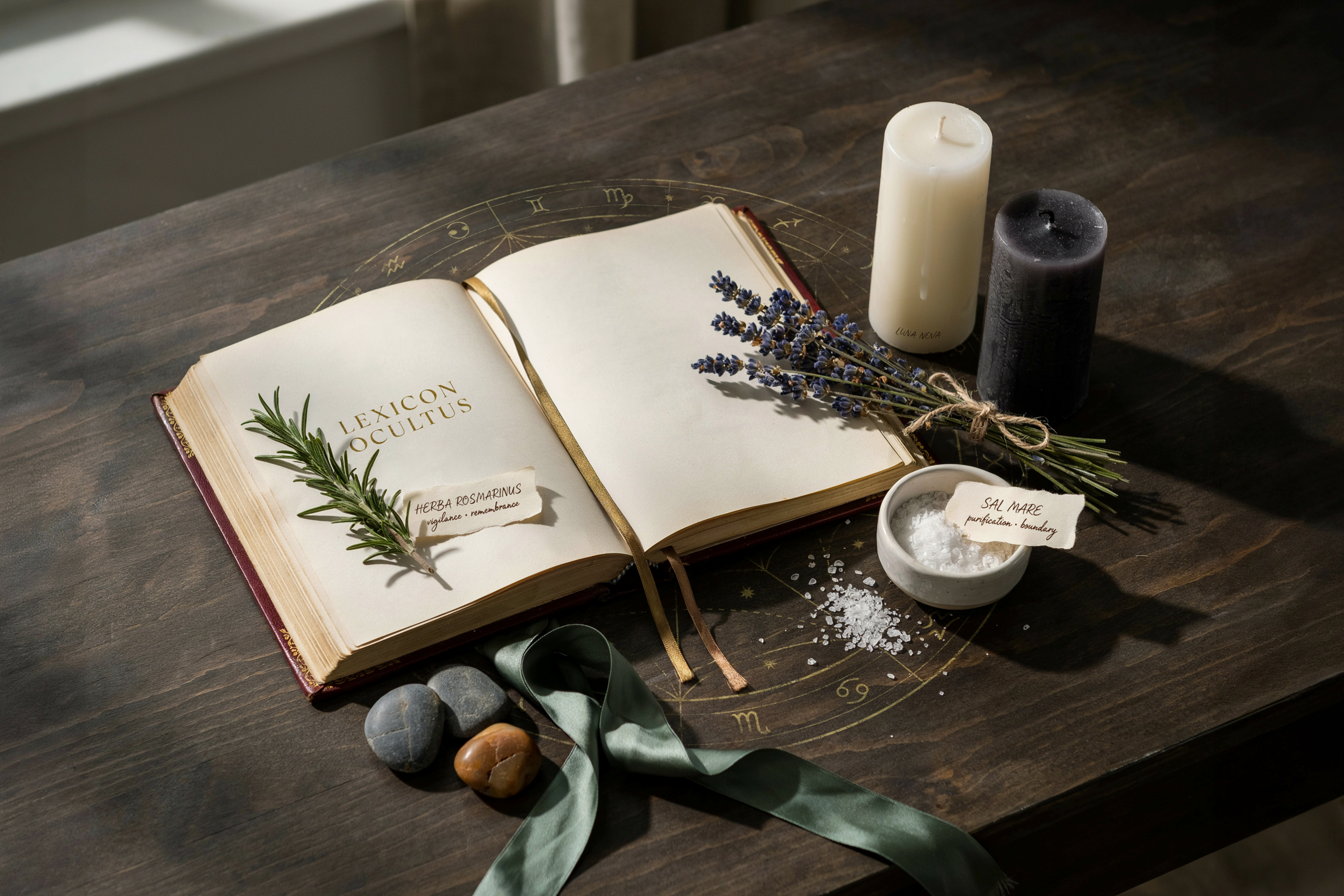
Correspondence
A correspondence is a symbolic, energetic, spiritual, or traditional association used in witchcraft, magic, ritual, and esoteric practice. Correspondences connect objects, colors, plants, planets, elements, numbers, days, symbols, or natural forces with particular meanings or magical purposes.
In witchcraft, correspondences are often used to select materials for spells, rituals, charms, altars, offerings, and devotional work. They form a system of symbolic relationship, allowing the practitioner to choose items that align with a specific intention.
Definition of Correspondence
A correspondence is an association between a person, object, substance, symbol, time, place, or force and a particular magical meaning, quality, or purpose.
For example, rosemary may correspond with protection, remembrance, cleansing, or fidelity. The color green may correspond with growth, prosperity, fertility, healing, or the natural world. The Moon may correspond with intuition, emotion, cycles, dreams, fertility, mystery, and the unseen.
Correspondences are not always fixed. They may vary by culture, tradition, source, region, historical period, and personal practice.
Meaning of Correspondence in Witchcraft
In witchcraft, correspondences act as a symbolic language. They allow a practitioner to build ritual meaning through selected materials and associations.
A spell for protection might include black candles, salt, rosemary, iron, obsidian, protective symbols, or a waning moon. A ritual for growth might include green candles, basil, seeds, fertile soil, spring imagery, or the waxing moon.
The correspondence gives each object a role within the working. It is not merely decoration. It becomes part of the ritual’s structure and meaning.
Common Types of Correspondences
Correspondences may be drawn from many systems of magical, folk, occult, religious, astrological, herbal, and spiritual symbolism.
Common types include:
- Color correspondences
- Herb correspondences
- Crystal correspondences
- Planetary correspondences
- Elemental correspondences
- Lunar correspondences
- Seasonal correspondences
- Animal correspondences
- Number correspondences
- Directional correspondences
- Deity correspondences
- Tarot correspondences
- Astrological correspondences
- Day-of-the-week correspondences
- Symbol correspondences
Each type creates a system of meaning that can be used in ritual or magical work.
How Correspondences Are Used
Correspondences are commonly used to choose materials for a magical purpose. A practitioner may select a candle color, herb, crystal, moon phase, day of the week, or symbol because it aligns with the desired intention.
For example, a spell for clarity might use air symbolism, yellow or white candles, mint, quartz, written words, feathers, or the planet Mercury. A ritual for emotional healing might use water symbolism, blue candles, lavender, moonstone, shells, bowls of water, or lunar timing.
The correspondence supports the focus of the working. It gives the intention a physical and symbolic form.
Correspondence Tables
A correspondence table is a list or chart that records magical associations. These tables may appear in grimoires, books of shadows, spell books, occult texts, herbal references, astrology guides, or modern witchcraft resources.
A correspondence table might list herbs and their magical meanings, colors and their ritual uses, planets and their associated qualities, or crystals and their symbolic properties.
These tables are often used as reference tools. However, they should not be treated as the only possible authority. Correspondences are shaped by tradition, but also by context and interpretation.
Traditional Correspondences
Traditional correspondences are associations inherited from older magical, religious, folk, herbal, astrological, or occult systems. They may come from ceremonial magic, folk magic, classical astrology, herbal medicine, mythology, religious symbolism, or regional custom.
For example, the Sun has long been associated with vitality, power, authority, success, illumination, and life force in many symbolic systems. Saturn is often associated with boundaries, time, limits, endings, discipline, age, and structure.
Traditional correspondences provide continuity. They connect modern practice to older symbolic frameworks.
Personal Correspondences
A personal correspondence is an association developed through individual experience, intuition, memory, environment, or repeated practice.
A plant, color, object, animal, or symbol may carry a particular meaning for one practitioner because of personal history or spiritual experience. For example, lilac may represent protection to one person, grief to another, and ancestral memory to someone else.
Personal correspondences do not necessarily replace traditional correspondences. They may exist beside them.
Cultural and Historical Context
Correspondences should be understood within cultural and historical context. A symbol may hold one meaning in one tradition and a different meaning in another. A plant used for protection in one region may be used for mourning, blessing, healing, or love in another.
For this reason, correspondences are not universal in a simple or absolute sense. They are symbolic relationships shaped by place, history, language, religion, folklore, and practice.
Responsible use of correspondences requires attention to origin, meaning, and context.
Examples of Correspondences
Common examples of correspondences include:
- Rosemary: protection, cleansing, remembrance, clarity
- Lavender: peace, sleep, purification, calm
- Salt: protection, purification, preservation, boundary-setting
- Black: protection, banishing, absorption, mystery
- White: cleansing, blessing, clarity, spiritual purity
- Green: growth, prosperity, fertility, renewal
- Fire: transformation, will, passion, action
- Water: emotion, intuition, healing, dreams
- Earth: stability, grounding, fertility, material matters
- Air: thought, communication, movement, intellect
- Waxing Moon: growth, attraction, increase, development
- Waning Moon: release, banishing, reduction, removal
These examples are common in modern witchcraft, but they are not the only possible meanings.
Correspondence vs. Symbol
A symbol is an image, object, sign, or form that carries meaning. A correspondence is the relationship between that symbol or object and the meaning assigned to it.
For example, a crescent moon is a symbol. Its correspondences may include intuition, cycles, mystery, dreams, the divine feminine, night, or lunar magic.
The symbol is the visible form. The correspondence is the chain of meaning attached to it.
Correspondence vs. Association
The words correspondence and association are closely related. In magical practice, correspondence usually refers to an association used intentionally within ritual, spellwork, divination, or spiritual symbolism.
An association may be general. A correspondence is usually functional within a magical or symbolic system.
Are Correspondences Required?
Correspondences are not required for every magical practice, but they are widely used. Some witches rely heavily on correspondence systems. Others use them lightly or selectively.
A spell may be built around detailed correspondences, or it may be built around direct intention, prayer, energy, spirit work, folk custom, or personal symbolism.
Correspondences are tools of structure. They help organize meaning, but they are not the only source of magical power.
Misconceptions About Correspondences
A common misconception is that every object has one correct magical meaning. In reality, many objects have multiple correspondences.
Another misconception is that correspondence lists are universal. While some associations are widely repeated, many differ across traditions, cultures, and sources.
A third misconception is that a spell will fail if every correspondence is not perfectly matched. In practice, many witches use correspondences as supportive tools rather than rigid rules.
Correspondences in Spellwork
In spellwork, correspondences help create alignment. The chosen materials, timing, colors, words, tools, and symbols all point toward the same purpose.
A prosperity spell might use green or gold, basil, cinnamon, coins, Thursday, Jupiter symbolism, the waxing moon, or seeds. A protection spell might use black, salt, rosemary, iron, protective sigils, boundary imagery, or a waning moon.
The spell becomes a constructed language. Each item speaks toward the same intention.
Correspondences in a Grimoire
Many practitioners record correspondences in a grimoire or book of shadows. These records may include traditional lists, personal observations, ritual results, seasonal notes, plant meanings, crystal associations, planetary meanings, and spell outcomes.
Over time, a grimoire may become a personal correspondence system. It can show not only what a source says something means, but also how that symbol behaves within the practitioner’s own practice.
Related Terms
- Magic
- Witchcraft
- Spell
- Ritual
- Intention
- Energy
- Symbol
- Grimoire
- Book of Shadows
- Herbal Magic
- Crystal Magic
- Color Magic
- Planetary Magic
- Element
- Moon Magic
Summary
A correspondence is a magical or symbolic association between an object, material, color, plant, planet, element, symbol, time, or force and a specific meaning or purpose.
In witchcraft, correspondences are used to shape rituals, spells, altars, charms, offerings, and magical records. They create a language of relationship, where each chosen item contributes meaning to the work being performed.
Correspondences are useful, but they are not absolute. They may be traditional, personal, cultural, historical, or intuitive. Their power lies in the way meaning is recognized, chosen, arranged, and applied.




Leave a Reply