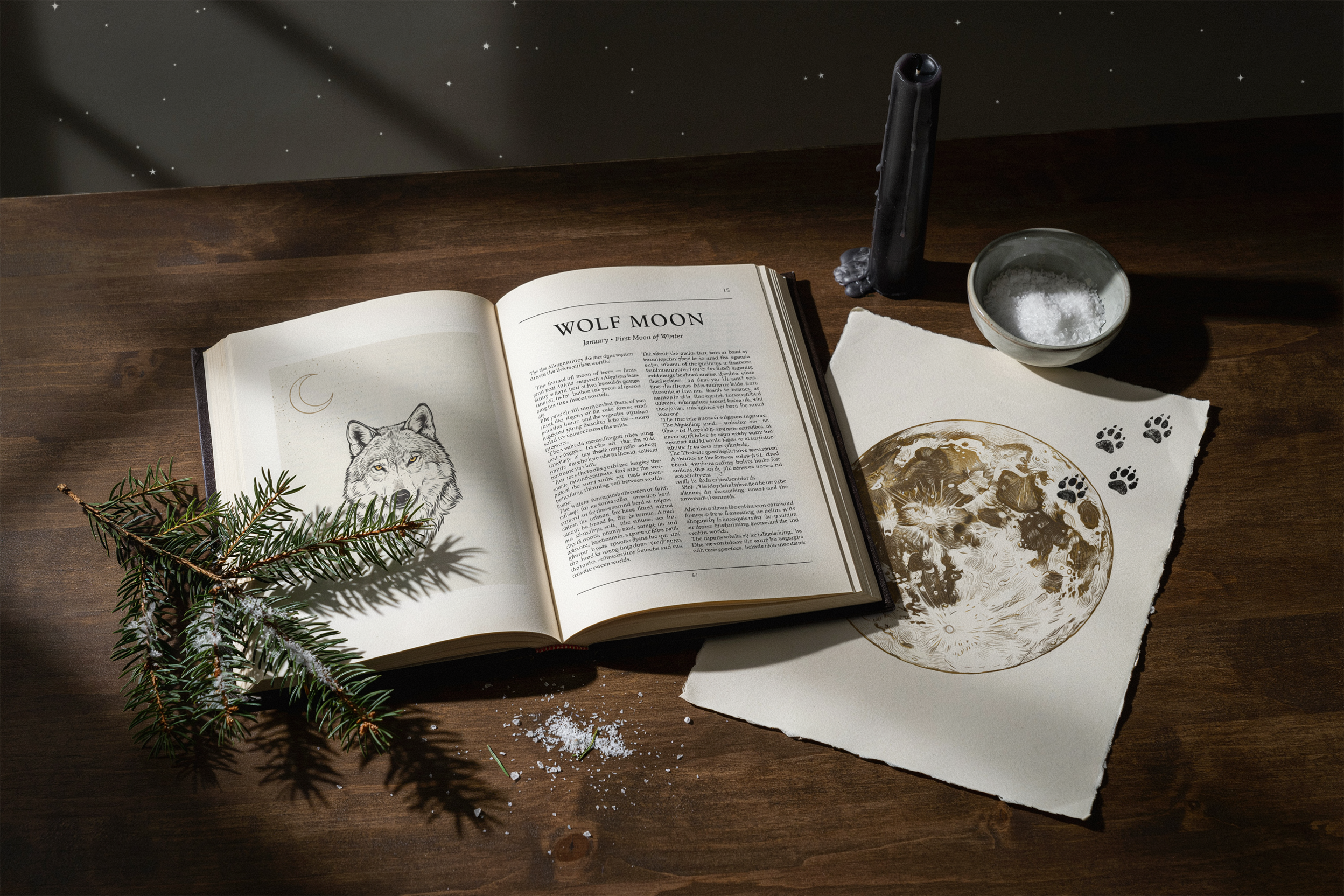
The Wolf Moon is a traditional name for the full moon that occurs in January. It is associated with winter, hunger, endurance, instinct, protection, survival, and the deep silence of the cold season.
In witchcraft and seasonal spirituality, the Wolf Moon is often interpreted as a full moon of inner strength, boundary-setting, ancestral memory, and listening to what rises in stillness.
Definition of Wolf Moon
The Wolf Moon is the name commonly given to the January full moon.
It is one of several traditional full moon names used to mark the lunar cycle through the year. These names are often connected to seasonal changes, animal behavior, agricultural rhythms, weather patterns, and folklore.
The Wolf Moon belongs to the coldest part of the year in the Northern Hemisphere. Its name evokes the image of wolves calling through winter darkness, when food is scarce and survival depends on instinct, cooperation, and awareness.
Meaning of the Wolf Moon in Witchcraft
In witchcraft, the Wolf Moon is often associated with endurance, instinct, protection, shadow work, spiritual listening, and winter wisdom.
It is a full moon of hunger and awareness. Symbolically, this hunger may be physical, emotional, spiritual, creative, or ancestral. The Wolf Moon asks what is needed, what has been neglected, and what must be protected during the barren season.
Because it occurs near the beginning of the calendar year, the Wolf Moon is also associated with clarity, intention, and the first serious turning inward after the noise of midwinter celebrations has faded.
Seasonal Symbolism of the Wolf Moon
The Wolf Moon belongs to deep winter. The land is often cold, bare, quiet, and dormant. Growth is not yet visible, but survival continues beneath the surface.
Common seasonal themes of the Wolf Moon include:
- Cold
- Snow
- Hunger
- Silence
- Survival
- Instinct
- Protection
- Pack bonds
- Endurance
- Inner listening
- Winter wisdom
- Ancestral memory
The Wolf Moon is not a moon of softness or abundance. It is a moon of attention. It belongs to the part of the year that reveals what can endure without ornament.
Why Is It Called the Wolf Moon?
The name Wolf Moon is commonly linked to the sound of wolves howling during the winter season. In folklore and seasonal naming traditions, January’s full moon became associated with wolves because their presence and calls were especially noticeable in the cold, dark part of the year.
The wolf has long carried symbolic meanings of instinct, wilderness, loyalty, guardianship, hunger, danger, and freedom. These associations shape the spiritual meaning often given to the Wolf Moon in modern witchcraft.
The name does not mean wolves howl only during this moon. Rather, the name reflects a seasonal image: wolves calling across the winter night.
Wolf Moon Correspondences
Wolf Moon correspondences may be used in altar work, spellwork, journaling, divination, or seasonal ritual.
Common correspondences include:
- Colors: white, silver, gray, black, deep blue
- Animals: wolf, owl, raven, deer
- Elements: water, earth, air
- Herbs: rosemary, cedar, pine, mugwort, bay, juniper
- Crystals: moonstone, obsidian, smoky quartz, clear quartz, hematite, selenite
- Symbols: wolf tracks, snow, bones, evergreen, moonlight, lanterns, thresholds
- Themes: protection, instinct, survival, clarity, boundaries, endurance, inner guidance
- Season: deep winter
- Moon phase: full moon
These correspondences are symbolic rather than universal. A practitioner may adapt them according to tradition, region, climate, and personal practice.
Magical Uses of the Wolf Moon
The Wolf Moon may be used for magical work connected to protection, instinct, boundaries, strength, release, and winter reflection.
Common magical uses include:
- Protection work
- Boundary-setting
- Shadow work
- Ancestral reflection
- Strengthening intuition
- Releasing fear
- Listening to inner guidance
- Clarifying needs
- Cleansing after the old year
- Setting serious intentions
- Strengthening spiritual discipline
- Honoring winter’s quiet
The Wolf Moon is especially suited to magic that requires honesty. It is a moon for naming what is real, even when the landscape is bare.
Wolf Moon and Protection
Protection is one of the strongest themes of the Wolf Moon. The symbolic wolf represents watchfulness, loyalty, territory, and survival.
A Wolf Moon ritual may focus on protecting the home, strengthening spiritual boundaries, cleansing a threshold, blessing protective charms, or renewing wards.
This full moon may also be used to examine what protection actually means. It may involve guarding energy, preserving rest, ending draining patterns, or recognizing where boundaries have become too weak.
Wolf Moon and Instinct
The Wolf Moon is often connected to instinct and primal knowing.
In magical practice, instinct refers to the deeper awareness that notices danger, opportunity, truth, or misalignment before the rational mind fully understands it. The Wolf Moon may be used for divination, dream work, meditation, or journaling that explores intuition and inner warning signs.
This moon does not ask for performance. It asks for attention.
Wolf Moon and Shadow Work
Because the Wolf Moon occurs in the darkness of winter, it is often associated with shadow work. This may include examining fear, loneliness, survival patterns, anger, grief, hunger, or the parts of the self that have been exiled or ignored.
The wolf as a symbol may represent both the feared and the faithful. It may reveal the wild self, the protective self, the hungry self, and the self that knows how to survive.
Wolf Moon shadow work may focus on the question: what has been calling from the dark?
Wolf Moon and Ancestral Memory
The Wolf Moon may also be connected to ancestry, memory, and inherited survival. Winter often evokes older human realities: shelter, food, fire, family, danger, story, and endurance.
An ancestral Wolf Moon practice may include lighting a candle, leaving an offering, recording family stories, reflecting on inherited strengths, or acknowledging the resilience of those who came before.
This does not require romanticizing the past. It may simply recognize that survival itself is a lineage.
Wolf Moon Ritual Themes
A Wolf Moon ritual may be built around themes such as:
- I protect what is sacred.
- I listen before I act.
- I honor my instincts.
- I release what weakens my spirit.
- I remember what has helped me survive.
- I strengthen my boundaries.
- I move through winter with awareness.
- I return to what is essential.
These themes may be used in spellwork, meditation, altar design, journaling, or divination.
Wolf Moon Altar Ideas
A Wolf Moon altar may include objects connected to winter, protection, instinct, and lunar energy.
Possible altar items include:
- A white, silver, gray, black, or deep blue candle
- A bowl of snow or water
- Pine, cedar, rosemary, or juniper
- Moonstone, obsidian, smoky quartz, or clear quartz
- A wolf image or paw print symbol
- Salt for protection
- A small lantern or candleholder
- Bones, antlers, or natural winter objects where appropriate and ethically sourced
- A written intention for protection or clarity
- A divination tool
The altar may be sparse. The Wolf Moon does not require abundance. Its symbolism is strongest when the space feels clear, focused, and intentional.
Wolf Moon Journaling
Journaling during the Wolf Moon may focus on survival, need, instinct, and protection.
Possible prompts include:
- What am I hungry for in a deeper sense?
- What part of me has been calling for attention?
- Where do I need stronger boundaries?
- What instinct have I been ignoring?
- What helps me feel protected?
- What did I survive that deserves recognition?
- What must be released before the year can truly begin?
- What wisdom does winter reveal when I stop resisting it?
These prompts may be used in a grimoire, moon journal, or personal reflection practice.
Wolf Moon vs. Other Full Moons
Each named full moon carries seasonal symbolism. The Wolf Moon is distinct because it belongs to the first full moon of the year and the heart of winter.
Where the Flower Moon may symbolize blooming, the Harvest Moon may symbolize gathering, and the Cold Moon may symbolize stillness, the Wolf Moon emphasizes instinct, hunger, protection, survival, and attention.
It is a moon of listening for what moves in the dark.
Misconceptions About the Wolf Moon
A common misconception is that the Wolf Moon has one fixed spiritual meaning. In practice, its meaning varies by tradition, region, source, and practitioner.
Another misconception is that the Wolf Moon must be associated only with wolves. While the wolf is the central symbol, the moon’s broader meaning may include winter, hunger, endurance, protection, instinct, and spiritual attention.
A third misconception is that the Wolf Moon is always gentle or comforting. Its symbolism can be stark. It may reveal needs, fears, boundaries, and truths that have been ignored.
Related Terms
- Full Moon
- Moon Magic
- Lunar Magic
- Moon Phase
- Winter Magic
- Protection
- Boundary
- Shadow Work
- Ancestor Work
- Correspondence
- Ritual
- Altar
- Divination
- Cleansing
- Wolf
Summary
The Wolf Moon is the January full moon, traditionally associated with wolves, winter, hunger, instinct, endurance, and survival. In witchcraft, it is often used as a time for protection, boundary-setting, shadow work, ancestral reflection, and listening to inner guidance.
The Wolf Moon belongs to the deep winter landscape. It does not promise immediate growth. Instead, it reveals what must be guarded, what must be heard, and what remains alive beneath the cold.




Leave a Reply